
Coming Home
THE ODYSSEY (2026)

“How do you come home from war?” Peter Lucier asked in America Magazine back in 2019. Lucier served as a Marine Corps infantry rifleman from 2008 to 2013, including a 2011 deployment in Afghanistan. He found the transition back to civilian life more difficult than expected, especially as he began to feel the moral weight of what he’d done while serving. He wrote:
I went to war feeling entitled. To what exactly? To save. To kill. It didn’t occur to me how arrogant that was until I came home. I carried that self-centeredness into a marriage after I got home and wrecked it. The uniform I wore reminds others of service. It reminds me of all the wrongs I’ve done and continue to do.
War carries many obvious, visible costs — costs so obvious and visible that it’s baffling that anyone who isn’t directly profiting from them keeps supporting them. But war also has an invisible cost for the people who fight it. According to the National Center for PTSD, 7% of veterans will suffer from PTSD at some point in their lives. Vets have significantly higher rates of suicide and addiction disorders than the civilian population. And for some there’s the cognitive dissonance that Lucier describes, of being praised for actions that haunt you.
How do you come home from war? For many veterans, the real question is: Can you?
My favorite thing about Christopher Nolan’s The Odyssey is that it’s a horror film.
Oh, sure, it’s an epic adventure and a melodrama and a rousing blockbuster, too. But instead of a strange and sometimes awe-inspiring journey, Nolan presents Odysseus’ journey as a series of Very Bad Things, where every new island makes you go “Oh no oh no oh no go back to the boats go back to the boats.” That’s baked into the plot, of course: there are a ton of monsters and Odysseus’ entire crew dies before the end. But Nolan’s approach is so visceral and, frankly, mean that it makes the material more frightening than ever before.
These are skills Nolan has demonstrated before: his career started with noirs and all of his blockbusters are uniquely haunted. The Odyssey is perhaps his closest to a “pure” horror film, which sums up his approach to the material in general. This isn’t the story of a strange and heroic journey; it’s a descent into Hell, where our hero’s sins take on flesh (and armor) and come howling for his blood.
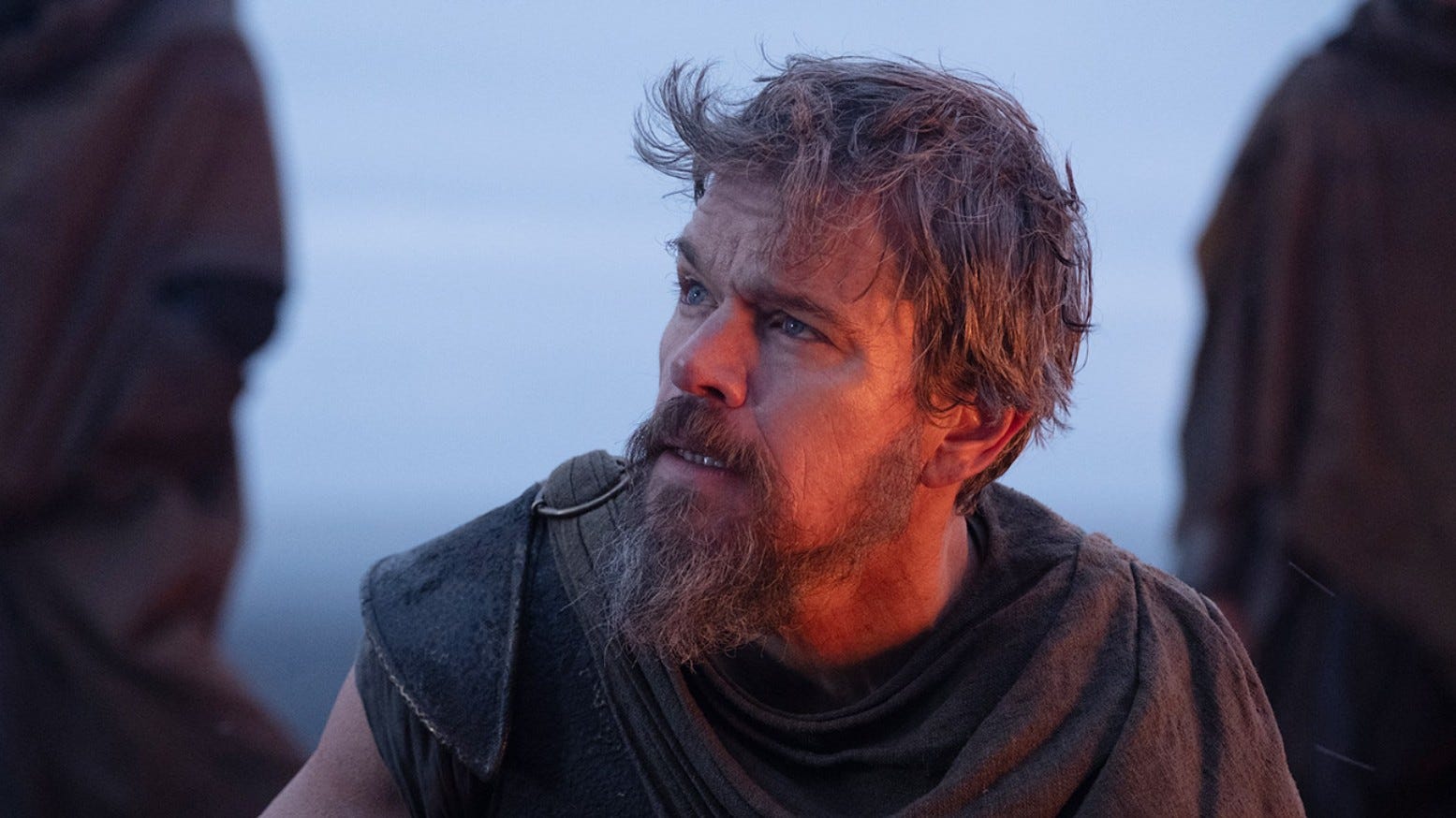
If Nolan’s films are haunted then the same is true for his protagonists. Odysseus (Matt Damon, shouldering the role made famous by Wishbone) joins a line of troubled men stretching from J. Robert Oppenheimer back to Leonard Shelby in Memento, crushed by the weight of their sins and self-flagellating their way towards redemption. Like Interstellar, Tenet, and especially Oppenheimer, it’s also suffused with existential dread, a suffocating anxiety that human greed and violence have irreparably broken the world. In the wake of the Trojan War, Odysseus shares the same fear that Oppenheimer voiced at the end of that film: that the apocalypse is already underway, and all we can do now is regret it.
The Odyssey’s case for this is a bit sweatier than Oppenheimer’s (it involves the defiling of hospitium, the Sea Peoples, and the end of the Bronze Age, which probably felt apocalyptic at the time but inspires less modern anxiety than, say, nuclear annihilation). The film is at its weakest when characters spell out those big themes; Nolan’s never been a master of dialogue. But he is a master of depicting guilt (the man was raised Catholic, he comes by it honestly) and that’s what The Odyssey is all about. In Oppenheimer, you at least had the minor concession of knowing that our hero’s opponents were opportunistic, vindictive, and just as guilty as he is. The Odyssey, even with its monsters and loutish suitors, offers no such relief. Odysseus is guilty as hell.
He knows it, too. Just like in the poem he is cursed by the gods and suffers the typical brutalities of Olympian justice. In both poem and film it’s a trial; but in Nolan’s telling, he knows he deserves it.
In Homer, Odysseus is cursed for harming Polyphemus, Cyclops son of the sea god Poseidon. In the film, however, Odysseus is cursed because of how he won the war.
The Trojan Horse is a fairly evil stratagem in any telling, although I think centuries of retelling have worn off the edges. It’s not just the use of deception — Odysseus’ brainchild, of course, the craftiest of the Greek heroes — but the scale of it. The Greeks appear to retreat, leaving the horse behind. The Trojans think the war is over. They think they’re safe. And then one night soldiers drop from this supposed gift of the gods, throw open the gates of their city, and slaughter them in their beds.
It’s horrific, but of course that’s not how it’s sold. The film begins with a bard (Travis Scott) introducing the story of the Trojan War: “A face, a fleet, a war, a man, a thought, a trick—a trick to break the walls of Troy and burn it screaming to the ground!” There’s no shame there, just celebration. The war was won by defiling the sacred laws of hospitality. The lesson the victors took from that was: It worked.
“The oftentimes adoring American public does not talk much about my sins,” Lucier wrote in his America essay. “In the American culture, I am loved for my sins. I am loved for being a Marine who went to war.” Odysseus shoulders a similar burden, and over the course of the journey it curdles into self-hatred. Damon plays it all with wounded restraint, his initial muscular machismo giving way to weary fatalism.
Homer’s Odyssey is an epic not a tragedy, but it brushes up against that genre, and Nolan’s adaptation leans into it. We get the Oresteia in brief (Lupita Nyong’o showing, once again, the seismic impact she can have even with a small performance1), and of course there are all of Odysseus’ doomed shipmates. But the film’s Odysseus is a doomed figure as well. Like Oppenheimer, he realizes that he’s struck the match that will burn his world down, and now can only watch helplessly. And (drawing from Shakespearean tragedy more than Greek) he’s also damned to be very good at doing something very bad, namely: tricking people and murdering them. Like many (anti-)heroes of that variety, he eventually surrenders to his dark gift and uses it to save Penelope (Anne Hathaway) and Telemachus (Tom Holland).2
But again, it’s not a tragedy, which means that even the doomed hero gets a happy ending.3 Or, at the very least, he gets to achieve some measure of redemption.
Lucier eventually realized that the only way for him to truly come home from war was “the path of penance.” For him it took the form of truth-telling about the sins of war, a penitential pilgrimage, and finally reparations. “We killed some teenage kids while I was in Afghanistan,” he wrote. “I now teach kids who are about the same age. I cannot bring back those killed in war. But I have got to do something to try to repair the world.”
Nolan’s Odyssey is similarly a journey of confession and penance. Much of the film is framed as Odysseus telling his tale to Calypso, and the film’s climax (even more so, I’d argue, than the action scene that follows) is when Odysseus confesses his gravest sins to Penelope and the ever-present Athena (Zendaya, also showing what a great actor can do with limited screentime). Nolan’s lapsed Catholicism has never been more apparent: as Joshua Johnson pointed out on Letterboxd, that scene even involves a screen and foot-washing.
It’s a radical shift in perspective, to see the violence and war-heroism of the story as inherently corrosive: horrors that will just beget more, worse horrors. In some ways that idea is undercut by the cathartic brutality in the film’s final action set piece, when Odysseus slaughters the suitors. But it’s also the only honest conclusion for the story Nolan’s telling.
The ultimate lie of war is that all of the horror is acceptable because it happens Over There. But look at the world — tanks rolling through inner-city neighborhoods, smoke grenades plunging into crowds of protestors, school days interrupted by the deadly percussion of assault rifles — and you see the truth. War always comes home.
Things Seen & Heard
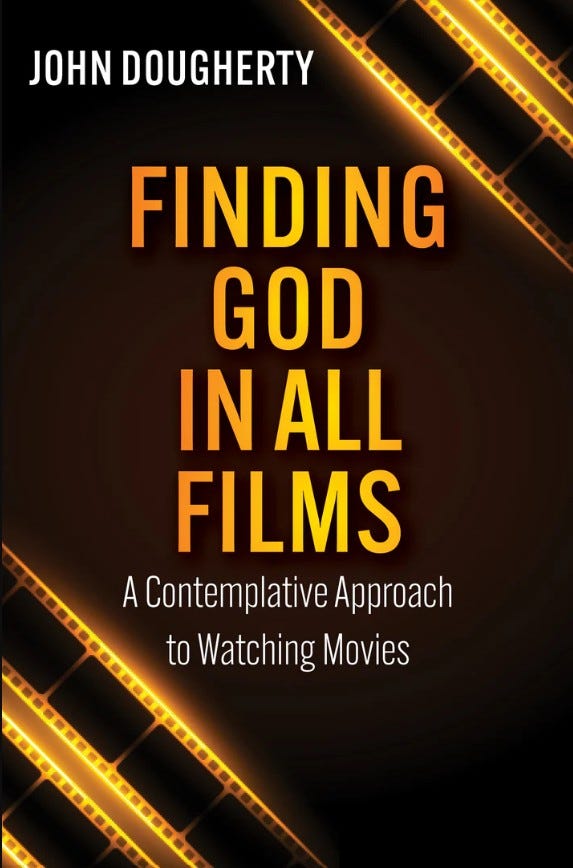
Publishers Weekly reviewed my upcoming book, Finding God in All Films: A Contemplative Approach to Watching Movies (Orbis, 2026)! You can preorder it here!
Movie News Corner: I keep saying “I don’t really care about the MCU anymore” and then I hear that Ryan Coogler’s doing Black Panther III with David Jonsson and ::siiiiiiiiiiiiiiiiigh:: I’m back on the hook again. More excited for his next original project, but excited for this too!
In case you missed it, I wrote about the real Odyssey last week, O Brother, Where Art Thou? (2000) and the sanctity of stupidity in the Coens’ films. In that post I also mentioned that I’d created a Spotify playlist for my own amusement called The Coen Brothers Sing-Along. I mention this again as an excuse to share the masterful cover art I made for said playlist. Truly, graphic design is my passion:

Also fun to see her playing a dual role again after Us.
I wanted to focus on Odysseus in this piece which didn’t give me room to talk about all of the other great players in this ensemble, but I want to give special mention to Hathaway who is really great in this. It’s a showier performance than, say, Samantha Morton’s Circe (which is, rightly, getting a lot of praise) but that’s a feature not a bug in my mind: Penelope has to spend so much time suffering in silence, it really works when Hathaway gets to let loose.
It’s like one of those Wolverine stories where he uses his incredible talent for murder to protect an innocent, but not one of the ones where he’s old and dies at the end. Just one of the ones where he goes back to the school or whatever and feels guilty about it. Do they still have the school? I lost track mid-Krakoa arc.
This is a generous review of a movie that was, for me, difficult to watch--battering and bruising. I was with a friend who left after a few minutes, it was that overwhelming to him. As an antiwar film, a movie about trauma and what it does to perpetrators, it works. As a faithful interpretation of the epic poem, it felt to me flat and suffocating.
This articulates just about all of my thoughts and feelings on this film. Great piece!