
No Other Choice
An angry post inspired by an angry movie

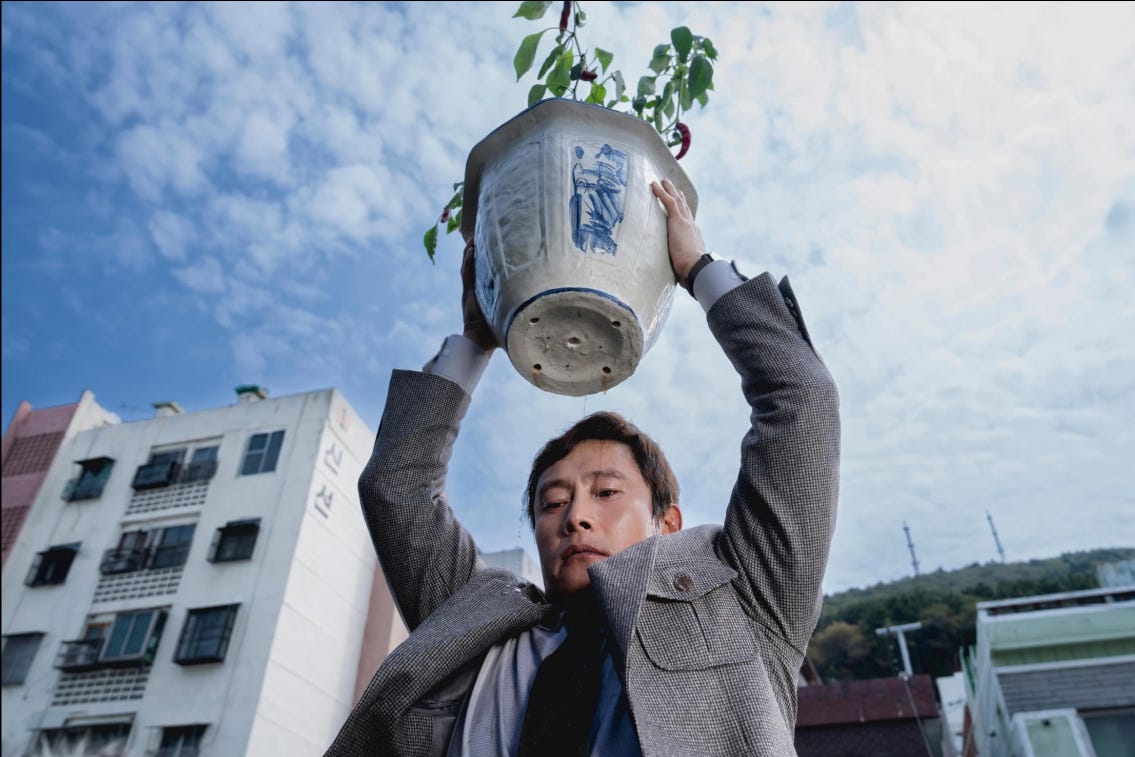
I caught Park Chan-Wook’s No Other Choice (2025) this week at the Philadelphia Film Society. It’s good! Very funny, very bleak!
If you’re unfamiliar, the basic plot is as follows: after 25 years of working at a papermaking company, Man-su (Lee Byung-hun) is one of many employees who gets axed when the company is bought by an American conglomerate. Desperate to find employment, he decides to kill a manager at another papermaking company, creating a vacancy. But as he’s preparing to brain said manager with a large potted plant, he realizes that this man’s death won’t actually solve his problem. And so he does the only logical thing: he identifies the candidates who might beat him out for the job once it opens and plans to kill them first.
This is an all-timer in the “characters say the title of the movie in the movie” category. The first time we hear “no other choice,” it’s tossed off by an American executive escaping a confrontation about all of the jobs his company is cutting. Throughout, others will use it to defend other callous decisions, big and small — including murder. Despite the outward appearance there is not, Park suggests, so much of a difference between companies jettisoning their employees and Man-su’s homicidal brand of job hunting. In the former the violence is implicit, hidden behind corporate politesse and faux-compassionate HR language: but in the end, it’s the exploitation, erasure, and destruction of people so that the company, and its owners, can get ahead. Through Man-su, Park makes that violence explicit.
Of course, there are other choices. I’ve gone through several job search processes, and haven’t murdered anyone! But this is the world that we’re building: a world where violence and dehumanization are so ingrained that it really feels like there is no other choice. The point isn’t (exclusively) that Man-su has been forced into horrible acts by late stage capitalism: it’s that he’s internalized and accepted that implicitly-violent worldview. Human labor, and human life, are increasingly cheap commodities in this world (which is underlined in the film’s spectacularly grim ending, which I won’t spoil here). Nothing and no one can get in the way of the bottom line. Man-su stretches that logic a little, but not as far as we might like to think.
The theologian Walter Brueggemann talks about this in his book The Prophetic Imagination when he discusses “the royal consciousness,” the mindset of power and prosperity. The royal consciousness cannot imagine any alternatives to the present system because that would mean endangering its own hegemony. The way things are is the only way things can be, human society in its final and best form, “a situation in which everything was already given, in which no more futures could be envisioned because everything was already present a hundredfold.”1
You could apply that description to a lot of things in our current society, but I think it’s especially apparent and insidious in our discourse around state violence. When a cop or an ICE agent guns down an unarmed person — which, of course, happened in Minneapolis this week — we’re told that this is just the way things have to be. We have the freest, safest, best nation on the planet and also at any time a law enforcement officers can shoot you dead and face little to no consequences. In the lead up to those little-to-no-consequences, people ranging from your fellow citizens to elected officials will do everything in their power to blame you for your own death. You were disrespectful, you were erratic, you were threatening to this armed man in his body armor and his mask. He was afraid. He had no other choice.
There is one narrative, and that is: the state can kill whoever they want, whenever they want, and you’re not allowed to complain about it. By suggesting that there are other alternatives, you’re being naive, unrealistic, and possibly treasonous. Our society can only function if violence is an accepted fact of life. Does that sound messed up to you? Clearly you don’t appreciate your freedom and safety enough.
“Our culture,” Brueggemann writes, “is competent to implement almost anything and to imagine almost nothing.”2 We can pour billions into new and more efficient ways to kill people, but a world without school shootings is just too fanciful to be believed. It’s easy to pin this all on conservatives, but this is a bipartisan American problem: try bringing up nuclear disarmament or prison abolition to a moderate liberal. We can’t imagine a world that isn’t underpinned by horrific violence, and so we claim that it’s the only option available to us.
The idea that there is “no other choice” is both a lie and a self-fulfilling prophecy: if you tell people that they must accept a system of constant violence, then violence is what you’ll get. But we don’t have to accept it. In contrast to the royal consciousness, Brueggemann offers the prophetic imagination which conjures new futures and hopes. A prophet’s job, he writes, is to “nurture, nourish, and evoke a consciousness and perception alternative to the consciousness and perception of the dominant culture around us.”3 In the broadest sense that means testifying to the belief that there are other choices, that a better world can exist.
Brueggemann also talks about the role of artists in envisioning a new world. This is all stuff that I’ve touched on before in this newsletter and at another time might dive into here. But, frankly, I’m too angry for that right now. I’m not feeling terribly hopeful and my little artistic gestures feel pathetically inadequate as a response to everything that’s happening.
I wrote this, mostly, to say that there is another choice. I think it’s important to believe that, even if it feels hopeless. To not accept this broken, brutal system as the best and only possible reality. I don’t have a lot of hope at the moment, but I do have a lot of anger and that means I can still say no. That’s something.
Anyway, go see No Other Choice.4 It won’t make you feel better about the state of the world but you will laugh a lot, and that’s something, too.
Things Seen & Heard
For more of my thoughts on No Other Choice, a very good movie, read my Letterboxd review. And hey, why not follow me on Letterboxd while you’re over there!
Take care of yourselves. Praying for all of us. Don’t give up, don’t give in.
Brueggemann, The Prophetic Imagination, 25.
Ibid., 40.
Ibid., 3.
Usual disclaimer: It worked for me, it won’t necessarily work for you. It’s a very black comedy and often violent, but those are things I can roll with; maybe they’re not your cup of tea! Regardless, it’s a very well-made movie.
We keep seeing previews for this movie and I keep wanting (and now I want even more after reading this!) to see this movie!!